
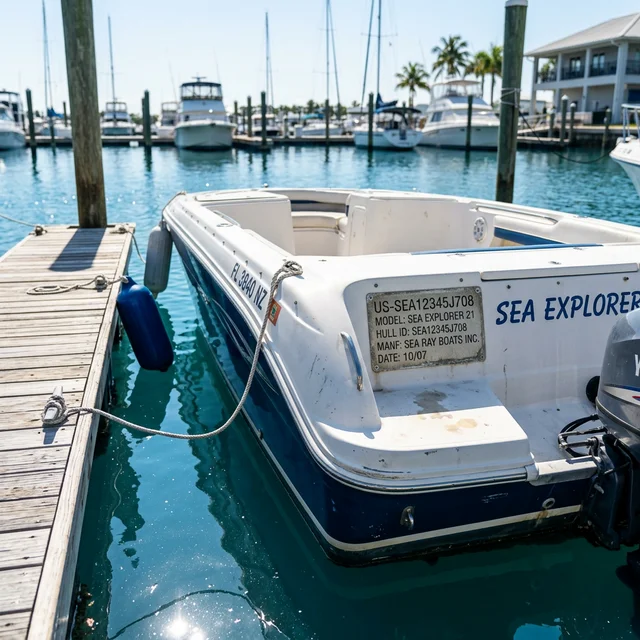
Before You Buy: Pre-Purchase Checks
Before completing a used boat purchase, perform these critical checks to protect yourself legally and financially:
1. Verify the Hull Identification Number (HIN)
Every manufactured boat has a unique 12-character HIN permanently attached to the transom. Verify that:
- The HIN on the boat matches the HIN on the title and registration documents
- The HIN has not been altered or tampered with
- The HIN format follows the standard pattern (3-letter manufacturer code + 5 serial characters + month/year)
2. Check for Liens
A lien means someone else (usually a bank) has a financial claim against the vessel. You can:
- Ask the seller for a lien-free title or lien release documentation
- Check with your state's titling agency for existing liens
- Use a professional boat history service for comprehensive records
3. Verify Registration Status
Confirm the boat's registration is current and matches the seller's identity. An expired or mismatched registration is a red flag.
Documents You Need from the Seller
When purchasing a used boat, you should obtain the following from the seller:
In States Requiring Titles
- Signed title — The seller must sign the title over to you on the designated assignment section
- Bill of sale — Include the date, purchase price, vessel description (make, model, year, HIN), and both parties' full names and addresses
- Current registration certificate
- Lien release (if applicable) — Proof that any loan has been paid off
In States Without Titles
- Bill of sale — This becomes your primary proof-of-ownership document
- Current registration certificate
- Prior bills of sale — A chain of ownership documentation is important
Additional Helpful Documents
- Maintenance records and service history
- Original manufacturer's documentation
- Coast Guard documentation (if the vessel was federally documented)
- Insurance records
Step-by-Step Used Boat Registration
Step 1: Complete the Title Transfer
In title states, you must transfer the title to your name before you can register the boat. This typically involves:
- Submitting the seller-signed title to your state's DMV or DNR
- Completing a title application form
- Paying the title transfer fee (typically $10-$25)
- Paying applicable sales or use tax on the purchase price
Step 2: Apply for Registration
With the title transfer complete (or bill of sale in hand for non-title states), apply for registration:
- Complete the boat registration application form
- Provide the HIN and vessel specifications
- Pay the registration fee based on your boat's length class
Step 3: Sales/Use Tax Considerations
Most states charge sales or use tax on used boat purchases based on the purchase price or fair market value (whichever is higher). Key points:
- Delaware has no sales tax — a significant advantage for buyers
- Some states cap the tax amount (e.g., Georgia caps at a certain value)
- If you paid sales tax in another state, you may receive credit against your home state's tax
Step 4: Display Your New Registration
Remove the seller's old registration numbers and decals. Display your new registration number on both sides of the bow following your state's display rules.
Buying from a Dealer vs. Private Seller
| Aspect | Dealer Purchase | Private Seller |
|---|---|---|
| Paperwork | Dealer handles most paperwork | You handle all paperwork |
| Sales Tax | Collected by dealer at purchase | You pay directly to the state |
| Title Transfer | Dealer processes the transfer | You process the transfer yourself |
| Lien Check | Dealer guarantees clear title | Your responsibility to verify |
| Warranty | May include limited warranty | Typically sold as-is |
| Price | Generally higher | Generally lower |
For private purchases, consider using an escrow service for larger transactions to protect both buyer and seller.
Buying a Boat Out of State
Purchasing a boat from another state adds complexity to the registration process:
Key Steps for Out-of-State Purchases
- Obtain the seller's state title and registration
- Transport the boat to your home state — You may need a temporary transit permit
- Apply for title and registration in your home state — Using the out-of-state documents
- Pay your home state's sales/use tax — You may receive credit for tax paid in the purchase state
Sales Tax Credit
If you paid sales tax in the state where you purchased the boat, most states will give you credit for that amount against your home state's sales/use tax. You'll only owe the difference (if any) between the two rates.
Common Mistakes to Avoid
- Not verifying the HIN — Always confirm the HIN on the physical boat matches all paperwork
- Skipping the lien check — You could be responsible for the previous owner's outstanding loans
- Under-reporting the purchase price — States may assess sales tax based on fair market value if the reported price seems unusually low
- Not getting a bill of sale — Even in non-title states, always get a written, signed bill of sale with all details
- Operating before registering — Don't take the boat out on the water until you have at least a temporary registration
- Forgetting to remove old registration numbers — You must remove the seller's registration numbers and display your own
Frequently Asked Questions
Do I need a title to register a used boat?
It depends on your state. Most states (about 40) require boat titles. States that generally do NOT require titles include Arizona, Colorado, Delaware, Kansas, Maine, New Hampshire, North Dakota, and Tennessee. Note that Alabama began requiring titles for certain vessels as of January 1, 2024. In non-title states, a bill of sale and previous registration are sufficient.
How do I pay sales tax on a private boat purchase?
When you register the boat, your state will assess sales or use tax based on the purchase price. You'll pay this at the same time you pay your registration fee. Bring a copy of the bill of sale showing the purchase price.
What if the seller lost the title?
The seller should apply for a duplicate title from their state's titling agency before the sale. If the seller cannot obtain a duplicate, some states offer a bonded title process — you purchase a surety bond (typically 1.5x the vessel's value) and the state issues a bonded title that becomes a full title after 3-5 years. Never buy a boat without resolving title issues first in states that require one.
How do I check if a boat is stolen?
You can check with the U.S. Coast Guard's stolen vessel database, contact your local law enforcement, or run the HIN through a boat history report service.
Do I need a survey or inspection for a used boat?
While not typically required for registration, a marine survey is highly recommended for used boats, especially for vessels over 26 feet. It can reveal hidden structural or mechanical issues.