
What Should a Boat Bill of Sale Include?
A boat bill of sale should identify the buyer, seller, vessel, Hull Identification Number, purchase price, sale date, included motor or trailer, and whether a title, registration, or lien release is being transferred. Many states ask for a bill of sale when registering a used boat, paying sales or use tax, or proving ownership in a non-title state.
What to Include
A useful boat bill of sale is specific enough for a state agency, tax office, lender, or future buyer to understand what changed hands. State forms vary, so treat this as a checklist rather than a universal legal form.
- Buyer and seller names with mailing addresses and contact information.
- Boat details including make, model, year, length, Hull Identification Number, and any agency-required description fields.
- Registration and title details such as state registration number, title number, documented-vessel status, and whether the original title is attached.
- Purchase terms including sale date, actual purchase price, deposit, trade-in value, and whether the sale is as-is.
- Included property such as outboard motor, trailer, electronics, safety gear, dinghy, or transferable slip equipment.
- Price allocation for the boat, trailer, and outboard motor when the state tax, title, or trailer office asks for separate values.
- Lien statement showing whether the seller promises the boat is free of liens or whether a lien release is attached.
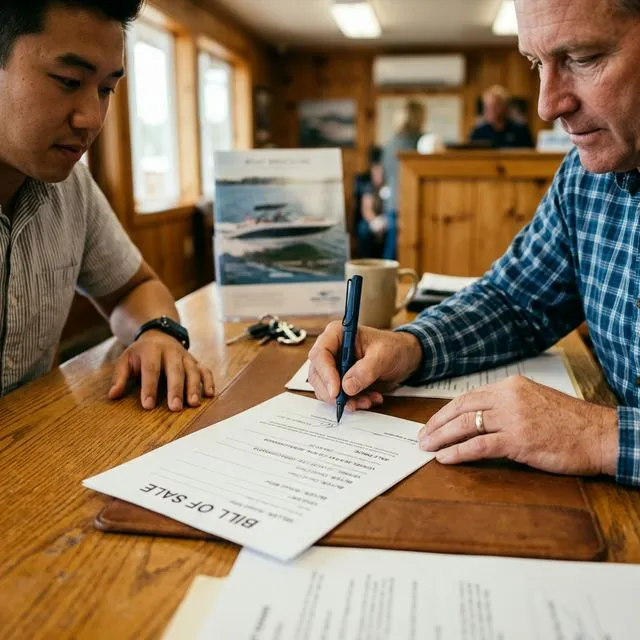
When a Bill of Sale Is Required
Requirements vary by state, but a bill of sale is commonly used in five situations: registering a used boat, transferring a title, proving purchase price for sales or use tax, documenting ownership in a non-title state, and separating what was included in the sale.
In a title state, the signed title is usually the main ownership document, but the bill of sale still helps support the purchase price, sale date, and lien-release trail. In a non-title state, the bill of sale may become one of the most important ownership documents because registration records may be the primary state record.
For a federally documented vessel, a normal private bill of sale may still help with state tax or registration records, but the ownership transfer usually needs USCG/NVDC documentation evidence such as CG-1340 Bill of Sale or another NVDC-accepted transfer document.
Some states require notarization for certain transactions or forms. If a state page or agency form calls for notarization, handle that before the buyer leaves with the boat.
Private Sale Checklist
- Match the HIN on the boat, title, registration, and bill of sale before signing.
- Confirm seller authority by matching the seller to the title, registration record, business authorization, or estate paperwork.
- List all included items so the trailer, motor, electronics, and accessories are not disputed later.
- Record the real purchase price because states may compare it to tax tables or fair market value.
- Attach lien proof if a lender was ever involved.
- Keep copies for registration, insurance, taxes, and future resale.
After the Bill of Sale Is Signed
After signing, the buyer should file registration or title paperwork as soon as the state allows. If the state has a deadline for transfer or tax payment, use the sale date on the bill of sale as the starting point unless the agency gives different instructions.
Before operating the boat, confirm whether the state allows temporary operation with the bill of sale on board. Some states allow a short grace period after purchase; others require registration or a temporary permit first.
Use the state guide directory when the document is ready and the next question is the local title, tax, registration, or no-title proof path. For a broader ownership-change workflow, pair this page with the used boat registration guide, boat title transfer guide, boat lien release guide, boat lien check guide, and USCG documentation guide.
Sale Document Decision Paths
Frequently Asked Questions
Is a boat bill of sale enough to register a boat?
Sometimes. In non-title states, a bill of sale and prior registration may be enough. In title states, the buyer usually also needs the signed title or another agency-approved ownership document.
Does a boat bill of sale need to be notarized?
It depends on the state and transaction. Some agencies require notarization for certain title transfers or forms, while others accept buyer and seller signatures without a notary.
Is there one standard bill of sale for every boat?
No. A generic bill of sale can document the deal, but use the state, tax office, or USCG/NVDC form when that agency requires a specific format.
Do documented vessels use a different bill of sale?
Often yes. Federally documented vessel transfers commonly use USCG/NVDC transfer evidence such as CG-1340 Bill of Sale or another NVDC-accepted document, even if a private bill of sale is also kept for tax or state records.
Should the trailer be on the same bill of sale?
List the trailer if it is included, but many states treat trailer title or registration separately from the boat. Include the trailer VIN, year, make, and price allocation when possible.
What price should be written on the bill of sale?
Use the actual purchase price. Under-reporting can create tax problems and may cause the agency to assess sales or use tax from fair market value.
Who keeps the original bill of sale?
The buyer should keep the original or a clear signed copy for registration and tax records. The seller should also keep a copy to document the sale date and release of ownership.