
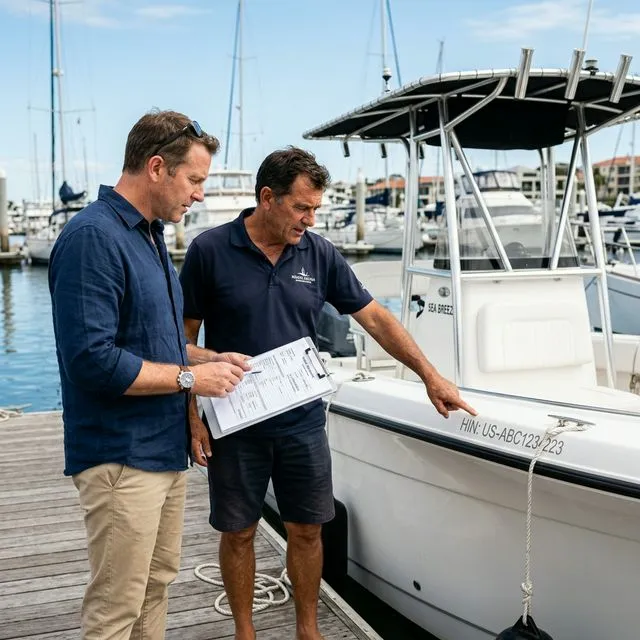
Do You Need a Boat HIN Inspection?
A HIN inspection verifies the Hull Identification Number on the physical boat and compares it with the title, registration, bill of sale, or agency record. States may require inspection for out-of-state boats, missing-title cases, homemade boats, rebuilt vessels, unclear ownership, or records with mismatched numbers.
Before filing or buying, call the state title or registration agency and ask who can inspect the boat, whether the boat must be physically present, which form or photos are needed, and whether a state-assigned HIN path applies if the number is missing or noncompliant.
What Is a HIN?
The Hull Identification Number is the boat's identifying number, similar in purpose to a vehicle VIN. Federal HINs use 12 characters and should be copied without spaces, hyphens, or slashes. State agencies, lenders, insurers, and law enforcement use the HIN to connect the physical vessel to ownership records.
For boats covered by the federal HIN rules, the primary HIN is generally on the starboard outboard side of the transom or near that area, and a duplicate HIN is placed in an unexposed location. Older, homemade, imported, or rebuilt vessels may have different markings or state-assigned numbers.
When a HIN Inspection May Be Required
- Out-of-state transfer when the new state wants to confirm the physical vessel.
- Missing or bonded title where ownership records need extra review.
- Homemade or rebuilt boat where the state may assign or verify a HIN.
- HIN mismatch between the hull, title, bill of sale, and registration.
- Older boat with damaged, altered, or unreadable HIN markings.
- Law-enforcement or theft review when records raise questions.
Inspection rules and authorized inspectors vary. The inspector may be a state agency employee, law-enforcement officer, game warden, DMV office, marine patrol officer, or authorized dealer depending on the state.
How to Prepare for Inspection
- Clean the HIN area so the inspector can read the characters.
- Bring ownership documents including title, registration, bill of sale, and lien release if available.
- Bring identification and any state inspection, title, registration, or assigned-HIN application form.
- Do not alter markings before inspection. If the HIN is damaged, missing, or looks noncompliant, let the agency document it and explain the state-assigned HIN path.
- Ask about trailer access if the boat must be physically present at an office, ramp, or inspection site.
What If the HIN Does Not Match?
If the HIN does not match, pause the transaction until the discrepancy is explained. A mismatch can be a simple paperwork typo, but it can also indicate a swapped hull, incorrect title, theft issue, or unresolved ownership chain.
Ask the state agency what correction path applies. The fix may require an inspection form, corrected title, seller affidavit, prior-state record, bonded-title review, or state-assigned HIN.
For a purchase workflow, pair this page with the used boat registration guide, missing title guide, and bill of sale guide.
HIN Inspection Decision Paths
Frequently Asked Questions
Where is the HIN on a boat?
On boats covered by the federal HIN rules, the primary HIN is generally on the starboard outboard side of the transom or near that area. A duplicate HIN is placed in an unexposed location.
Who can perform a HIN inspection?
It depends on the state. Authorized inspectors may include DMV staff, wildlife officers, marine patrol, law enforcement, or approved dealers.
Do all used boats need a HIN inspection?
No. Many normal transfers do not require inspection, but it is common for out-of-state, homemade, missing-title, rebuilt, or mismatched-record cases.
What if the HIN plate is damaged or missing?
Do not alter or replace it yourself. Ask the state agency how to document the issue and whether a state-assigned HIN is required.
Can a HIN mismatch stop registration?
Yes. If the physical boat and paperwork do not match, the agency may delay registration or title transfer until the record is corrected.