

Boat Registration Number Placement Direct Answer
Direct answer: boat registration number placement usually means the state-issued number must be displayed or attached on both sides of the forward half of the vessel, read left to right, use plain vertical block characters at least 3 inches high, contrast with the hull, and separate the letter and number groups with spaces or hyphens.
The U.S. Coast Guard establishes this baseline in 33 CFR 173.27. States can add decal placement instructions, renewal-sticker rules, or local enforcement details, but they generally build on the same federal display standard:
- Displayed on both sides of the forward half of the vessel, usually the bow area
- Read from left to right on each side
- Plain vertical block letters and numbers, at least 3 inches high
- A color contrasting with the hull so the number is distinctly visible and legible
- Separated by hyphens or spaces between the letter-number groups, such as FL 1234 AB or FL-1234-AB
- No confusing extra numbers in the same forward-hull area
Do not place the state number on the motor cowling, dashboard, capacity plate, transom, trailer, or a mid-hull area that is not the forward half. If your boat has a pontoon tube, rail, cabin structure, or hull shape that makes the forward side hard to read, use a flat backing plate or another state-accepted mounting surface on the forward half so the number remains visible from each side.
State Page vs This Guide
Use the state page when you need the local decal placement note, renewal timing, official agency path, or a state-specific certificate record.
Use this number-rules guide when the question is certificate of number display, hull placement, spacing, contrast, validation sticker or decal basics, and common display mistakes.
Registration Number Format
State-issued registration numbers often follow this pattern, though the exact letter and number group lengths are assigned by the state:
XX 1234 YY
Where:
- XX is the two-letter state prefix, such as FL, TX, CA, or MI
- 1234 is the numeric sequence assigned by the state
- YY is the letter suffix assigned by the state
Valid display examples
- FL 1234 AB or FL-1234-AB
- TX 5678 CD or TX-5678-CD
- CA 9012 EF or CA-9012-EF
- MI 3456 GH or MI-3456-GH
Invalid display examples
- FL1234AB, because the groups are not separated
- FL 1234AB, because the suffix is not separated from the number group
- FL 1234 AB in small script lettering, because the characters are not plain block characters at least 3 inches high
Size and Placement Requirements
| Requirement | Standard |
|---|---|
| Minimum letter height | 3 inches |
| Font style | Plain vertical block characters, no script or italic |
| Color | Must contrast with hull color |
| Location | Forward half of vessel, both sides |
| Orientation | Horizontal, reading left to right |
| Visibility | Must be clearly visible and readable underway |
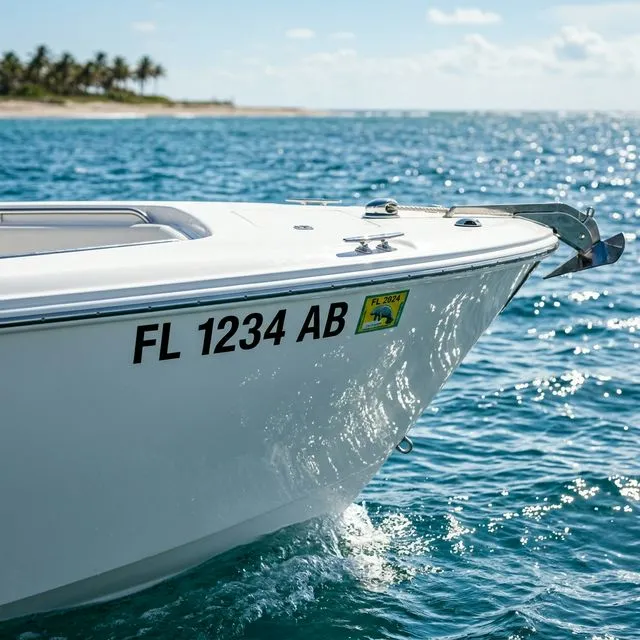
Validation stickers and decals
In addition to the registration number, most states require a current validation sticker or decal. Decal placement is state-specific. Many states place the decal within a few inches of the registration number, but the side, distance, and sequence can vary.
- Check whether your state requires one decal or decals on both sides
- Apply decals only after the hull surface is clean and dry
- Remove expired decals if your state instructs you to avoid stacking old stickers
- Keep the certificate of number on board when your state requires it
For exact decal placement, use the state page linked from our boat registration state directory before applying permanent vinyl.
Color Contrast Guidelines
The registration number must be a contrasting color to the hull. Here are recommended combinations:
| Hull Color | Recommended Number Color |
|---|---|
| White / Light colors | Black or dark blue |
| Black / Dark colors | White or yellow |
| Blue | White or yellow |
| Red | White |
| Green | White or yellow |
State-Specific Variations to Check
The federal number display rule is the starting point, not the whole checklist. State agencies decide how numbers are assigned, when registration expires, where validation decals go, and whether documented vessels need a state decal. Before you order vinyl numbers, confirm these details for your state:
- Decal location: some states specify port side, starboard side, both sides, or a distance from the number.
- Registration term: decals may expire annually, every two years, or every three years depending on the state.
- Documented vessels: federally documented vessels may not display state bow numbers, but some states still require registration, tax decals, or validation stickers.
- Dealer or temporary numbers: temporary operating permits can have separate display rules.
- Pontoons and inflatables: unusual hull shapes may need a backing plate or state-approved alternate mounting area.
Number, Decal, and Expiration Boundaries
Use this guide for display rules. It explains the certificate of number, bow-number format, 3-inch block letters, contrast, spacing, validation sticker or decal placement, and common display mistakes. Use a state page when the question names one state, and use the renewal deadline table when the question is about how long tags, tabs, decals, or a certificate remain valid.
- Missouri certificate of number: confirm the MO number format, validation decal placement, and the triennial certificate cycle on the Missouri page.
- Texas certificate of number renewal: confirm TX number display, decal placement, TPWD renewal, and 2-year certificate timing on the Texas page.
- Washington boat tabs: confirm WN number display, validation sticker placement, annual renewal, and watercraft excise tax notes on the Washington page.
- Illinois boat sticker: confirm IL number display, validation decal placement, and 3-year DNR registration timing on the Illinois page.
- NJ boat registration numbers: confirm NJ number format, 3-inch lettering, sticker placement, and MVC renewal or title steps on the New Jersey page.
If the decal or card is already missing, use the lost boat registration decals guide. If the question is when a registration, sticker, tab, or certificate expires across states, use the renewal deadlines by state table.
Common Display Mistakes
Avoid these common errors that can result in citations or delays at inspection:
- Numbers too small — measure the character height before applying vinyl.
- Wrong location — numbers belong on the forward half, not mid-hull, stern, console, motor, or trailer.
- No spacing — the three groups must be separated by spaces or hyphens.
- Poor contrast — faded numbers, reflective patterns, or low-contrast colors make the number hard to read.
- Script or decorative fonts — use plain block characters, not cursive, shadow lettering, or stylized marina fonts.
- Displaying old numbers — when a state assigns a new number, remove the old number so only the current one appears on the forward hull.
- Expired or misplaced decals — keep validation decals current and follow your state placement instructions.
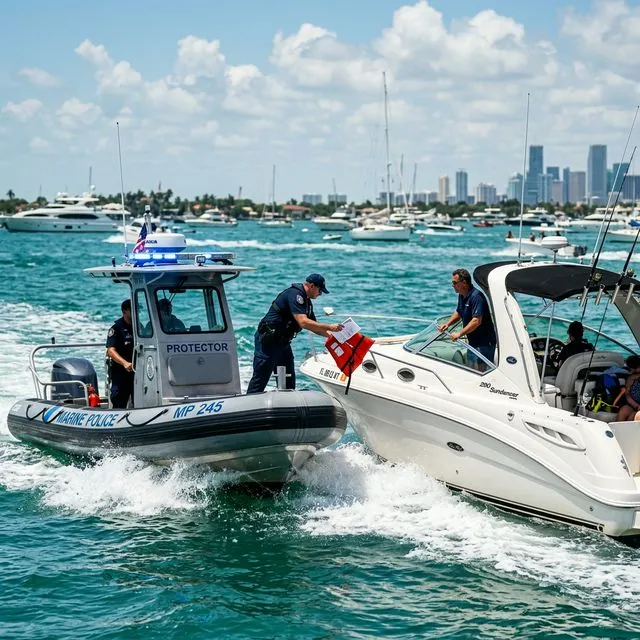
Quick dockside check
Stand several boat lengths away from the bow on each side. If you cannot read the full number quickly, improve the contrast, replace worn characters, or move the number to a clearer forward-hull surface before operating.
USCG Documented Vessels
Federally documented vessels follow different display rules. A documented recreational vessel typically displays its vessel name and hailing port together on a clearly visible exterior part of the hull, while the official number is permanently marked on a visible interior structural part of the hull.
- Display the vessel name and hailing port instead of state bow numbers
- Mark the official documentation number inside the vessel in a permanent way
- Do not display state registration numbers on the bow unless your state agency specifically instructs otherwise
- Still check state tax, decal, and registration rules because documentation does not erase every state obligation
For eligibility, marking, renewal, and fee details, see our USCG Documentation Guide.
Frequently Asked Questions
What size do boat registration numbers need to be?
Registration numbers must be at least 3 inches tall in block letters. They must be displayed on both sides of the forward half of the vessel.
Can I use vinyl numbers or do they need to be painted?
Both vinyl adhesive numbers and painted numbers can work, as long as they meet the size, color, spacing, visibility, and placement requirements.
Do I need to display the validation sticker?
When your state issues a validation sticker or decal, display it where the state tells you to place it. The side, distance from the number, and whether old decals must be removed can vary.
What happens if my numbers are too small or faded?
Law enforcement can cite you for improperly displayed registration numbers. Fines vary by state. Replace faded or damaged numbers promptly.
Where should I put the registration decal?
Check the state placement instruction before applying decals. Some states place the decal near the number, but the side, sequence, and distance are state-specific.